
Trauma Prevention starts with understanding what we haven’t yet named…the trauma gap™.
The Trauma Gap™ is the gap between what is known about human development and how behavioral health systems are designed to respond, unknowingly resulting in misdiagnosis, burnout, and ineffective care.
40% of high school students report persistent sadness or hopelessness. Suicide is the second leading cause of death for ages 10-34.
CDC Youth Risk Behavior Survey, 2023
1 in 3 young adults experienced a mental, behavioral, or emotional health issue in the past year (up from 1 in 5 in 2016).
SAMHSA, 2024
Trauma-informed care (TIC)
TIC is one of the most widely adopted frameworks in schools and healthcare. Unfortunately, TIC has become the ‘go-to’ training, shifting the focus on learning how to react to the presence of trauma. The bigger question is, how many of us know what perpetuates the trauma cycle and how to prevent it in the first place?

Most people only understand these as standalone diagnoses.
→ Anxiety
→ Depression
→ ADHD/ADD
→ Addictions
→ Oppositional Defiant Disorder (ODD)
→ Borderline Personality Disorder (BPD)
→ Substance Use Disorders
→ Eating Disorders
→ Self-Harm & Suicidal Ideation
The truth is - these are symPtoms of unprocessed trauma.
Interesting facts abouT trauma
HOW we’re different
Our approach doesn't start with behavior. It starts with development.
Most systems are asking: What's wrong with this person?
We ask: Where was this person's development interrupted?
That question changes everything. It shifts the lens
→ From pathology to capacity.
→ From diagnosis to understanding.
→ From managing symptoms to restoring what was disrupted.
This is where Jodee’s research lives, the space between what happened to someone and the developmental capacity that remains undeveloped.
We don't replace these modalities. We address what they can't reach.
FAQ | Do We Offer Trauma Training?
Yes, we offer Trauma Prevention Training exclusively to organizations that have completed our Behavioral Health Systems Study. Our study/assessment prepares the organizational conditions that allow training to hold, sustain, and produce measurable outcomes. Training delivered into an unprepared, struggling system is not sustainable. This sequence is not a policy. It is the science.
What other Approaches miss
What Social Emotional Learning (SEL) misses
Social-emotional learning has become a billion-dollar industry. But SEL programs lack a consistent definition.
Teaching a child to ‘manage’ their emotions assumes they have the developmental capacity to do so.
What if they don't?
what Dialectical Behavioral Therapy (DBT) misses
DBT is one of the most widely used therapeutic approaches. Yet meta-analyses show that more than 1 in 4 patients drop out.
What if we're asking people to regulate emotions that were never developed to begin with?
Cognitive behavioral therapy (CBT) misses
CBT is the gold standard of evidence-based therapy. But it relies on a person's ability to identify and reframe their thought patterns.
What happens when someone's emotional development was interrupted before those cognitive tools could form?
DISC, myer-briggs, eli, enneagram
Assessments like DISC, Myers-Briggs, Energy Leadership Index and Enneagram tell you what someone's patterns are. They don't tell you why those patterns formed or how to change them. They describe the map. They don't explain the terrain that built it, yet do not offer a solution to changing them.
The Trauma Gap™
The Trauma Gap™ is the gap between what is known about human development and how behavioral and mental health systems are designed to respond, often resulting in misdiagnosis, burnout, and ineffective care.
Current research shows:
→ Mental health diagnoses increased 35% (2016-2023)
→ PCPs write 70% of psychotropic medications w/ only 8 hrs of MH training
→ Teacher burnout is directly connected to managing behaviors.
→ Families are navigating crises they weren't trained for
-
The Trauma Gap™ refers to the gap between what is known about human development and how behavioral and mental health systems are designed to respond — often resulting in misdiagnosis, burnout, and ineffective care.
It’s perpetuated by the systemic disconnect between what we know about childhood developmental trauma (as the foundation of mental health struggles) and our inability to address it at scale.
Research confirms that adverse childhood experiences (ACEs) drive the majority of mental health diagnoses, yet our systems have no infrastructure to identify, treat, or prevent developmental trauma. Instead, we diagnose and treat symptoms, anxiety, depression, ADHD, addiction, while the fractured foundation remains untouched.
The result: diagnoses rise, treatments provide temporary relief at best, practitioners burn out, and intergenerational trauma cycles repeat.
The cost: Billions spent on interventions that fail because we never address the root cause. Individuals cycle through diagnoses and treatments while systems buckle under demands they were never designed to handle.
-
The Trauma Gap™ emerged from a fundamental flaw: our mental health infrastructure was built to treat diagnosed disorders rather than prevent and heal the developmental trauma that causes them.
For decades, systems focused on symptom management, diagnosing anxiety, depression, and behavioral disorders, while leaving the root cause unaddressed. Even as research confirmed the pervasive impact of adverse childhood experiences, our frameworks couldn't accommodate this knowledge.
Trauma-informed care represented progress, but remained reactive, teaching professionals to recognize triggers and respond with empathy after harm occurs, rather than building environments where developmental roots are understood, preventing perpetuation.
The predictable result: practitioners have become the overwhelmed as ‘Mental Health First Responders’ without adequate training, interventions providing temporary relief while patterns persist, and systems buckling under impossible demands.
The Trauma Gap™ persists because we lack infrastructure to move from reaction to prevention: no diagnostic frameworks for developmental trauma, no workforce training, no payment systems that support this work, and no coordinated implementation across sectors.
-
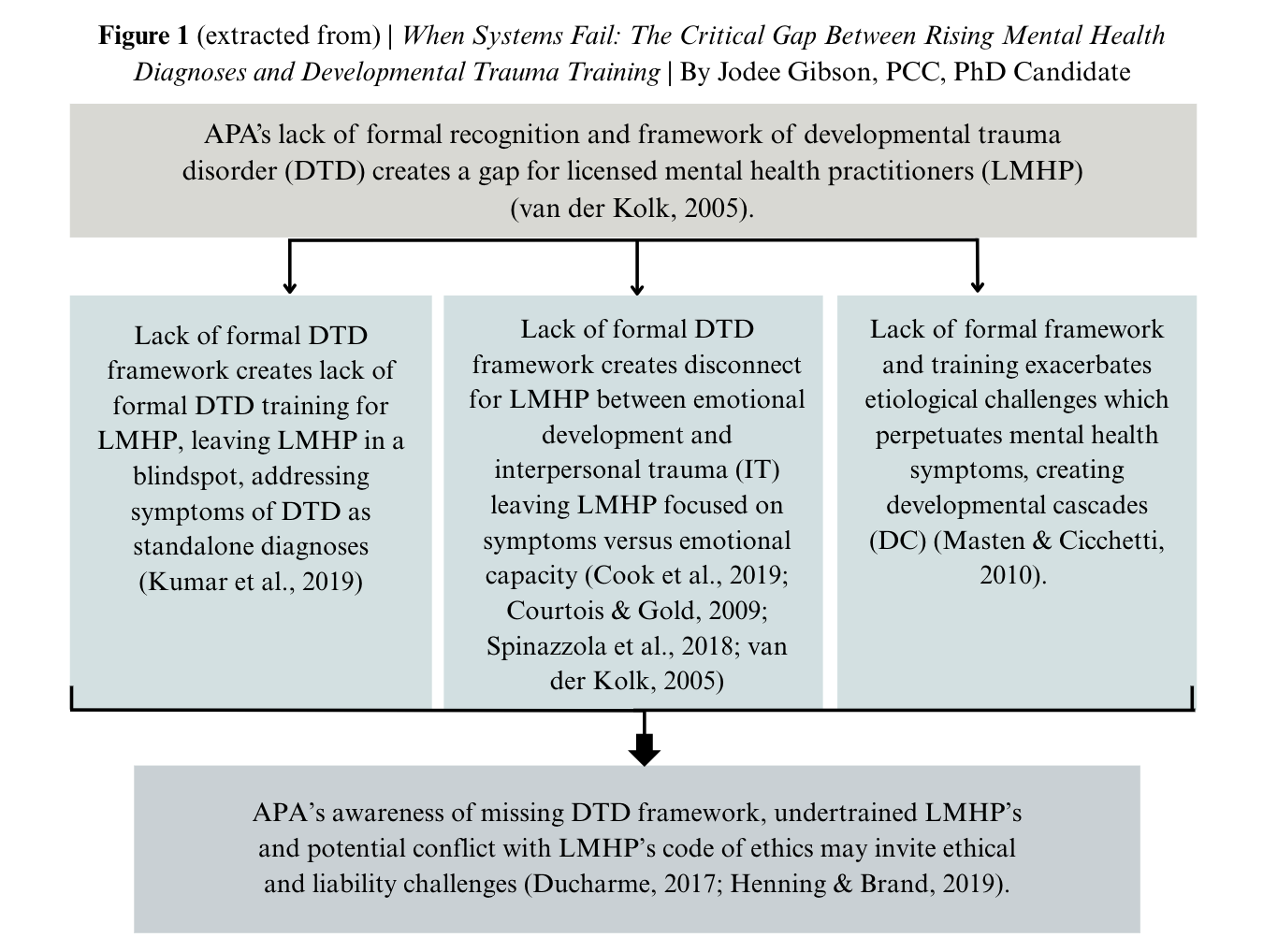
The gap exists across four critical system failures:
→ Diagnosis | No formal diagnostic framework for developmental trauma exists, forcing practitioners to treat symptoms while the root cause remains invisible and unnamed.
→ Workforce Training | Mental health practitioners are systematically untrained to recognize or treat developmental trauma, despite it being the foundation of most presenting diagnoses.*
→ Treatment Coverage | Insurance providers reimburse licensed mental health professionals for trauma services despite those providers receiving no trauma training, while excluding trauma-trained specialists who could provide effective care.
→ Implementation Infrastructure | Fragmented, siloed systems with no infrastructure to scale or coordinate evidence-based practices across sectors, leaving proven interventions inaccessible.
*While some practitioners pursue trauma training through continuing education, this remains fragmented, inconsistent, and absent from foundational professional training programs.
-
Closing The Trauma Gap™ requires coordinated transformation across policy, workforce development, systems infrastructure, and implementation, moving from a symptom-management approach to one that recognizes, addresses, and heals developmental trauma at its root.
The problem isn’t that we don’t understand trauma.
The problem is that our systems were never built to apply what we know.
The ABC(s) of
the trauma Gap™
These five patterns show up across healthcare, education, leadership, and family systems, regardless of intent.
-
Knowing better without doing better.
Most systems acknowledge that trauma, mental health, and human development matter.
Policies reference it.
Trainings mention it.
Conversations include it.
But awareness alone doesn’t change outcomes.
It’s like the concept ‘we are all products of our environments’ yet we’re diagnosing, labeling and medicating the ‘product’ instead of changing the ‘environment’ (or system). If insight doesn’t translate into action, for how systems are built, led, or run, the pattern will simply repeat.
This is where The Trauma Gap™ begins:
Changing the ‘environment’ (the system) automatically invites a new ‘product’.
-
Behavior is never the problem, it’s the outcome.
When behavior is evaluated without context, it’s treated as something to diagnose, manage, or correct. But behavior is simply the visible result of what’s happening beneath the surface, developmentally, relationally, and neurologically.
It’s like inspecting a product at the end of an assembly line and blaming it for defects, without ever examining the conditions that produced it.
Systems demand regulation without teaching it. They expect people to ‘calm down’, ‘comply’, or ‘function’ without understanding nervous system states or how dysregulation shapes behavior.
Without context, behavior is mislabeled, punished, or medicated instead of understood, and meaningful change never takes hold.
-
Asking individuals to carry what systems refuse to hold.
Care is expected at the individual level while systems remain unchanged. Professionals are asked to respond with empathy, patience, and skill, without the structures, training, or policies to support that work.
It’s like sending people into deep water with no equipment and calling it resilience when they don’t drown.
When systems aren’t designed with human development in mind, even the best care becomes unsustainable, leading to burnout, turnover, and moral injury.
-
Firefighting instead of fire prevention.
Most institutions are designed to respond after harm occurs. We’re living in a ‘trauma-informed’ world where ‘trauma-prevention’ is non-existent. We mobilize resources once something breaks, yet invest little in preventing the conditions that caused the breakdown in the first place.
This keeps systems in a constant state of reaction, mistaking urgency for effectiveness and crisis response for care.
The Trauma Gap™ widens when prevention is treated as optional and crisis becomes the norm.
People adapt to survive the system.
When behavior is misunderstood, regulation is unsupported, and systems remain unchanged, the human experience is flattened.
People adapt by disengaging, numbing, over-functioning, or breaking, doing whatever is required to survive the environment they’re in.
Over time, systems mistake these adaptations for personal failure, rather than recognizing them as signals that the environment itself needs to change.
This, my friends, is where my passion lives - in surfacing and addressing The Trauma Gap™
Download the Research
(coming soon)
Download our research and dig a bit deeper. | If you are still in the exploratory stage and want dive into the research, it will be available soon. We encourage you to stay connected. We will send it out as soon as it’s available.
The Trauma Gap™ white paper and assessment (coming soon) | Includes framework, research, and the four system failures breakdown.